
Do you ever feel overwhelmed by the growing expectations placed on today’s educators? Feel like there’s never enough time to build a strong rapport with your community while delivering a rich, modern curriculum? Blogging might help you in more ways than you’d expect!
Blogs have become a well-established part of the online landscape over the past decade. The educational blogging community continues to grow at a rapid pace — evidenced by the over four million blogs on Edublogs, and countless more across other platforms.
You may have no blogging experience at all, or you may have tried it before. Whatever your background, now is a great time to consider starting a new blog.
Here are ten reasons to integrate blogging into your classroom or professional practice — and make sure you read to the very end for a summary infographic you can share!
1. Home-School Connections:
Many teachers establish a class blog as a ‘virtual window into the classroom’. This was my primary purpose for beginning a blog back in 2008 before other advantages and uses became apparent.
Through reading and commenting on posts, families can be a part of what is happening in the classroom and have unmatched access to their child’s education.
Research shows that parent engagement is associated with improvements across a number of areas such as educational outcomes, behaviour and school attendance. Participating virtually now tends to suit many parents who are juggling careers and other demands. This is something that can be actively capitalized on through a classroom blogging program.
It is important to remember that most parents are busy people who need education and ongoing invitations to participate. As a teacher, I certainly found that actively encouraging parent participation in blogging was something that paid off. You may consider offering your parents: handouts, video tutorials, family blogging events, parent information evenings, commenting challenges or email newsletters.
2. Authentic Audiences:
In the traditional classroom, the only audience for student work was the teacher and sometimes classmates and parents. Blogs provide a much larger audience for student work and an avenue for feedback and self-improvement through commenting.
I found that students took particular pride when publishing work for our blog and often wanted to do their best for their impending audience. When we establish an authentic audience for our students we help them connect their classwork to the real world. After all, isn’t that what education is supposed to be about?
3. Literacy Skills:
With a class or individual blog, students are reading and writing for a purpose and genuine audience. Unlike other approaches to teaching literacy, where you may study a genre or style for a few weeks, blogging can be an ongoing occurrence in the classroom.
When high standards are set, and explicit teaching is embedded, a blogging program can be a powerful catalyst to improved literacy skills.
If we want our students to be motivated to use their emerging writing skills, we have to make writing purposeful, challenging, and real-to-life. Blogging offers this.
Traditional literacy skills are also no longer enough for our students. As innovative educator Silvia Tolisano points out, there are now many types of 21st literacies including: digital, media, visual and global literacies. A classroom blogging program can help integrate these literacies into your classroom seamlessly.
4. Classroom Community:
Creating a class blog requires teamwork and collaboration. Students and teachers can learn and share together. The Edublogs’ student and teacher challenges can be a great place to start this learning process.
A real sense of classroom community can be developed through blogging and establishing a class identity. Even if teachers are initially writing posts, students can take on roles and responsibilities such as capturing images, creating multimedia or replying to comments. A class blog mascot can also be a fun way to represent your classroom community.
5. Internet Safety:
Teaching students to be safe and responsible online is an increasingly important issue. Effective internet safety education does not involve one off lessons. This is a notion supported by the experts at Connect Safely who say internet safety concepts should be woven into the curriculum. They point out that students don’t distinguish between their digital lives and their personal lives, and there is a lot of power in using ‘teachable moments’ just as you would with any subject matter.
A classroom blogging program offers ongoing opportunities to discuss internet safety and appropriate online behaviours in an authentic setting. Blogging is an excellent way to learn about being a responsible member of an online community, digital footprints, netiquette, making safe choices and more. As Connect Safely identify, the key messages educators need to teach are: ‘think before you post’ and ‘be kind and respectful’. There is amazing potential to use blogging to promote these exact messages.
Using a platform like Edublogs offers you a lot of freedom to select the privacy settings that you and your community are comfortable with.
6. ICT Skills:
It can be easy to assume that students are ‘digital natives’ and come to school already equipped with a broad range of ICT skills. A review paper published in the journal Teaching and Teacher Education found that “information-savvy digital natives do not exist”.
Becoming an effective and fluent user of information technology requires explicit teaching and practice. Through blogging, many skills are able to be discussed and practised, often incidentally. These can range from keyboard shortcuts, coding, Creative Commons, research skills, using multimedia, troubleshooting and a lot more. Again, these learnings are all for an authentic purpose rather than through skill and drill exercises.
7.Global Connections:
I have found this to be one of the most exciting benefits of blogging for both teachers and students. Blogging can help flatten classroom walls like no other tool.
Over my years of blogging, my students and I got to know many classes across the world who we called our ‘blogging buddies’.
The benefits of global connections are priceless. A sense of understanding and tolerance develops and students can learn a lot about the world in which they live. Blogging partnerships allowed my students to learn from and with their global classmates about topics such as geography, cultures, time zones, seasons, language, internet safety and more.
When blogging is established in your classroom, there is also the possibility to organise or join in structured global projects. The opportunities and potential outcomes are endless.
And from a teacher’s perspective, once you become involved in blogging, your professional learning network can rapidly expand to be a lot larger than your school staffroom. You never know who you will meet and what wonderful relationships you can form!
8. Personal Development:
The process of blogging allows a lot of scope for personal development, for both students and teachers. Blogging offers reinforcement and feedback through comments beyond the immediate classroom community. This can drive self-esteem, personal reflection and growth, as well as confidence. Students and/or teachers may realize they have something important to say, and blogging may encourage individuals to speak their mind, reflect deeply and share their understandings.
Blogging is also a fantastic creative outlet. Whether it’s writing, designing your blog layout, or using photography, video, podcasts or other multimedia tools, blogs offer so much scope for creativity and fun. Blogs can also be used to showcase creative pursuits in art, music, sport, science or any other field.
A blogging program can also help to foster individual talents and passions while driving creativity and personal growth.
9. Lifelong Learning:
Blogging can be an excellent meta-cognitive process and avenue for reflection. The process of creating blog posts, allows you to ‘think about what you think’ and put those thoughts into words. Through delving into my thoughts on topics, and writing about what was happening in my classroom, I often came up with new ideas and strategies to use in my teaching. Additionally, when others offer thoughts and opinions on blog posts, you can be introduced to new perspectives that drive further reflection.
Effective teaching and learning does not occur in a vacuum, and establishing a broad network of global educators is priceless. It’s hard to believe that the majority of teachers are still relying on the insights of their immediate team or school when there are billions of people out there who can broaden their horizons!
Whatever position we are in, we must take advantage of the tools we now have for connecting beyond our immediate surrounds.
10. Blogging is versatile … and free!
What is a blog? It’s anything you want it to be really. It’s like asking ‘what is a classroom?’ We all know a classroom can be indoors, outdoors, in rows, in circles, big, small or even flipped. A blog is merely a website that can be customized to meet your individual requirements.
Blogs offer you the versatility to create a unique online space to represent yourself and/or your students and community. Unlike some online tools, blogging is completely free yet the potential uses and advantages are incomparable.
What Now?
You may be convinced, but what about your school leadership team or community? This post may help you to persuade them that it would be doing your students a disservice to not expose them to all the advantages that blogging offers.
Be sure to check out the infographic summary of this post too!
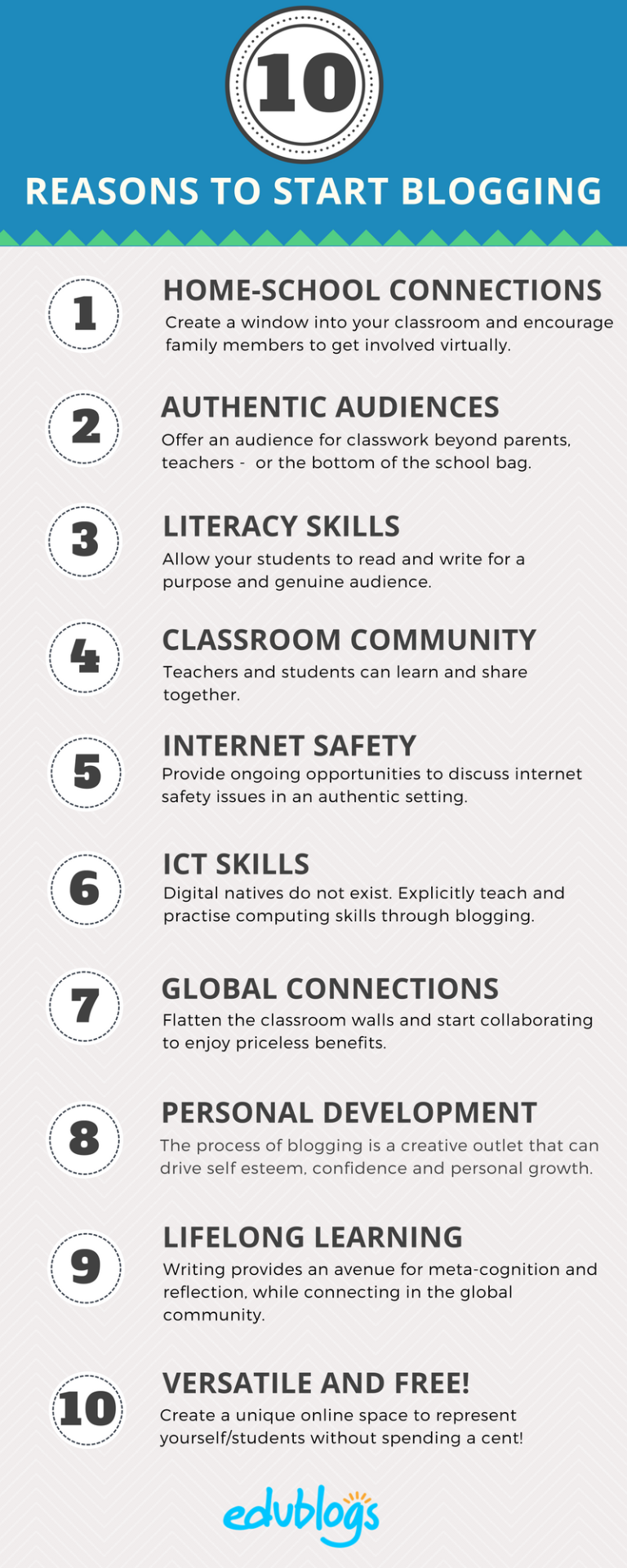
If you’re ready to start setting up a blog, click here. If the Edublogs team can help with any other questions about blogging, simply leave a comment or contact us on our help and support page.

Although I haven’t decided what topic to focus on in my blog, I am excited to use it as a tool in my classroom. It’s a fun way to encourage sharing and writing on a variety of meaningful topics.
I am so excited to learn about blogging and implement into my classroom lessons.
That’s fabulous, Angela. Good luck!
I like the idea of posting student’s work on the blog. I think that will be a great Motivator.
Become a blogger it help teachers to improve their skills and creative thinking. Thanks for sharing the informative blog with us.
Amazing post, I am an elementary education student and I loved reading all of your insightful ideas about blogging in the classroom. Being a student in the 21st century has truly changed how we teach our students and I am glad you embraced this in the best way possible. This post really made me excited for the endless possibilities I will have as a future teacher, so thank you.
So glad it was helpful for you, Emily. We love to see pre-service teachers get involved in the wider education community and see what’s possible. Good luck with your studies!
Fantastic post, I was just looking for ideas about what to write to encourage community involvement. I’m mostly a blogging beginner. (I enjoyed playing with one as part of my studies a few year’s ago but haven’t had the opportunity to explore this since walking into classrooms again.
Hi Mrs Buck,
I’m looking forward to seeing what you get up to with your blog this year. For more ideas for getting families involved, you might like to read this post https://www.theedublogger.com/edubloggers-guide-to-involving-parents-with-blogs/
It’s overwhelming the number of teacher’s blogs (14 to be exact, which is 2 children x 7 teachers) that need to be checked each day to make sure nothing is missed. Elementary school was so easy. It’s great that teachers are embracing technology and this form of communicating, however, it seems our school system needs to manage expectations. Do you have any ideas?
Hi there,
This sounds like a frustrating experience for you.
We’d love to be able to look into how the blogs are set up and help work out a solution to make the number of blogs easier to navigate. Would you be able to let us know the blog URLs? Perhaps you could contact us via email when you get a chance [email protected]
Thank you!
These are invaluable keys for opening so many doors. My favorite point was “flattening the classroom”. I love the idea of connecting with people outside of my little town. I want to reach and communicate with people from all over the world! Thanks for sharing and making the awesome infographic; nice digital bookmark.
Thank you, Matthew! Connecting with others around the world is my favourite part of blogging too! 🙂
That’s a great ten reasons to start blogging.
I teach an edtech course for pre-service teachers, and I always have each new class create their own blog. Some really catch on, some tolerate it … I will be adding a link to your post for their exploratory reading on “Why teachers should blog.”
And the inforgraphic is great too….I’ve already shared it on Twitter as a teaser for our up-coming class!
Hi Cammie, thank you so much for sharing. I hope you have lots of students who really get into blogging this time! 🙂
It is manageable fruitful websites to give us enjoyable continuing learning.
After starting a blog myself this summer I, too, came to the conclusion that my students need to be blogging in class. I’m calling the project Blog All the Books. There is so much potential for where this will go, this year and in the future. Thank you for the reinforcement!
Hi Carly,
What an exciting project! We’d love you to share the link to your blog with us. You’re right about there being so much potential.
Good luck!
Kathleen
‘Becoming an effective and fluent user of information technology requires explicit teaching and practice. Through blogging, many skills are able to be discussed and practised, often incidentally.’
This is a very important point that all teachers and parents need to be aware of. Often students are expert in a narrow area of technology but can provide rich, authentic tasks that grow our students in many areas of the curriculum.
All 10 points are very valid.
Hi Ange,
You’re right! From my experience, there seems to be a fairly incorrect misconception around that students are experts with all technology. It’s important not to fall into that way of thinking if we really want our students to grow.
So glad you enjoyed the post and thanks for commenting!
Kathleen